Study commission restructuring stop Limmatplatz Zürich, 2003
- 1/10
- Text
The Limmatplatz stop was conceived as a continuation of other important urban stops such as Paradeplatz, Bellevue, Central and Albisriederplatz. These stops are characterised by their architecture and setting, which are tailored to their respective urban and spatial situation. If we look at historical photos of the Limmatplatz from around 1930, the design of Limmatplatz is particularly striking for its radical urban planning and architectural clarity. A traffic island, built as a full ellipse, organised a perfect roundabout. The only elements in this urban void were four catenary poles, which gave this stop an almost surreal atmosphere. By 2004, this historic void was literally overgrown and obstructed so that the brilliantly formulated and complex Limmatplatz had become almost unreadable. Between these extreme points of tension, the project aimed to contribute to an urban clarification and upgrading. Both halves of the islands, separated by the tram tracks, were given clear areas. On the Langstrasse-side is the tram stop building, which integrates all use-related, technical and social functions. A group of plane trees was planted on the Kornhausbrücke-side. A table, fountain and bench, planned as park furnishing, were added. Analogous to the Paradeplatz, a second bus stop roof was deliberately omitted in favour of urban clarity and transparency.
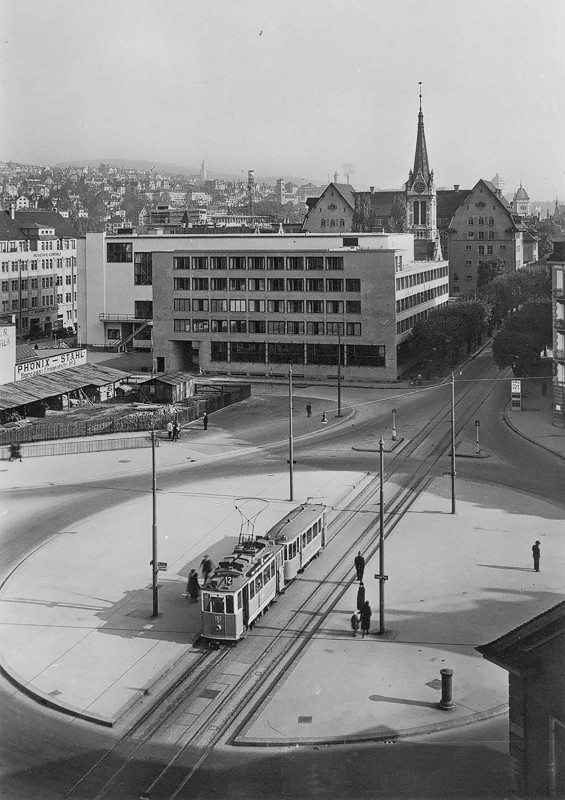
Limmatplatz 1934
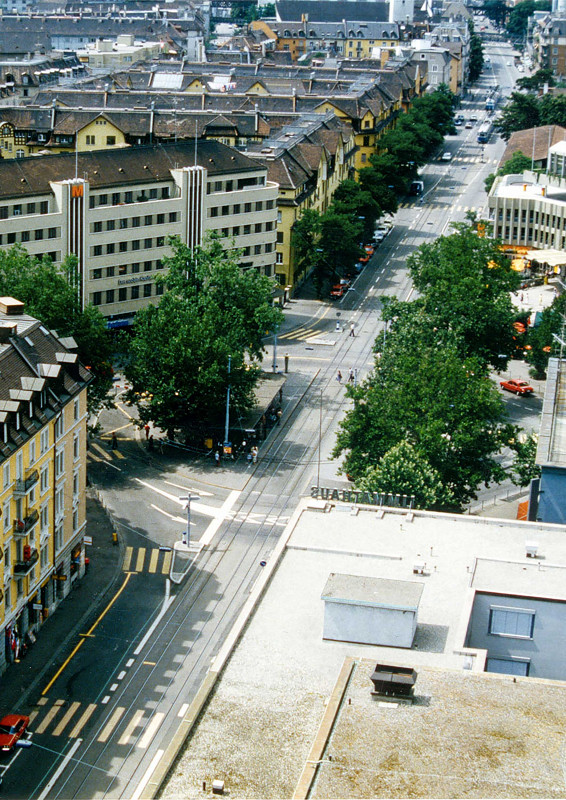
Limmatplatz 2004
Projektinformationen
Client
Stadt Zürich
Timeline
2003 Study commission
Architecture
Romero & Schaefle Architekten, Zurich
LANDSCAPE ARCHITECTURE
Vogt Landschaftsarchitekten, Zurich
STRUCTURAL ENGINEERING
Dr. Schwartz Consulting AG, Zug
PHOTOGRAPHY
Baugeschichtliches Archiv der Stadt Zürich; Romero Schaefle Partner Architekten AG